When being the "nice guy" isn't as
nice as you think.

By Richie Pryor, LMHC, Certified Relational Life Therapist
When you think of a controlling partner, what comes to mind?
Someone who yells? Someone who makes demands? Someone who tells their partner what they can and cannot do?
What about the person who never raises their voice, avoids arguments, agrees with everything, and insists they just want to keep the peace?
Could that person actually be controlling?
Absolutely.
Control doesn't always announce itself with anger and aggression. Sometimes it hides behind silence, avoidance, people-pleasing, and the seemingly innocent statement, "I just don't like conflict."
And sometimes the person who believes they're the least controlling person in the relationship is quietly determining what their partner is allowed to talk about.
Meet Mr. Nice Guy

Let me introduce you to Tom and Sarah, a fictional couple representing a relationship dynamic I frequently encounter in my work with couples.
Tom is a nice guy. His friends love him. His coworkers think he's easygoing. He rarely raises his voice, and he prides himself on not being confrontational.
Sarah, however, experiences a very different version of Tom.
Whenever she brings up something that's bothering her, Tom becomes uncomfortable.
He sighs. He looks away. He gets quiet. Sometimes he leaves the room.
One evening, Sarah says:
"Tom, I feel like I'm carrying most of the responsibilities in this house, and I'm exhausted."
Tom responds:
"Here we go again. Nothing I do is ever good enough for you."
Sarah tries to explain that she's not attacking him. She simply wants to talk about something important.
Tom walks away.
Later, Tom tells himself that Sarah is controlling because she's always complaining and trying to change him.
But let's look at what actually happened.
Sarah brought up a concern. Tom became uncomfortable. Tom ended the conversation. Sarah's concern went unresolved.
Who actually controlled that interaction?
Tom didn't have to win the argument. He simply made it impossible to finish.
When Keeping the Peace Becomes a Form of Control

There's nothing inherently wrong with disliking conflict. Most of us would rather enjoy a peaceful evening than have an uncomfortable conversation with our partner.
The problem arises when your desire to avoid discomfort consistently takes priority over your partner's need to be heard.
Over time, Sarah begins asking herself:
Is now a good time to bring this up?
Is he going to get upset?
Will he shut down again?
Am I making too big a deal out of this?
Is it even worth saying anything?
Eventually, she stops bringing certain things up altogether.
She's walking on eggshells, carefully managing what she says to avoid an unpleasant reaction.
Meanwhile, Tom thinks things are getting better because they're arguing less.
But they're not getting better.
Sarah is simply giving up.
A reduction in conflict doesn't necessarily mean an increase in connection. Sometimes it means one person has stopped believing that speaking up will make a difference.
Five Ways Conflict Avoidance Can Become Controlling
1. Shutting Down Difficult Conversations

Whenever your partner brings up something uncomfortable, you withdraw, walk away, or refuse to engage.
You may believe you're preventing an argument, but you're also preventing a resolution.
When this becomes a pattern, your partner learns that difficult conversations can only happen on your terms.
2. Agreeing Just to End the Conversation
"Whatever you want."
"You're right."
"Fine, I'll take care of it."
You say what your partner wants to hear, not because you genuinely agree, but because you want the conversation to end.
Then you fail to follow through.
When your partner brings it up again, you accuse them of nagging.
You haven't resolved anything. You've simply postponed the conflict while creating another reason for your partner to distrust you.
3. Turning Accountability Into a Pity Party
Your partner expresses disappointment, and you respond with:
"I guess I'm just a terrible husband."
"I can't do anything right."
"You're never happy with me."
Suddenly, the conversation is no longer about your partner's concern. It's about your feelings of inadequacy.
Your partner may even find themselves comforting you instead of addressing the original issue.
Shame can be a powerful and automatic emotional response. But when it repeatedly prevents you from taking accountability, it becomes a barrier to intimacy.
4. Using Silence to Manage Your Partner
There's a significant difference between taking time to regulate yourself and using silence to punish or pressure your partner.
A healthy break communicates a need and includes a plan to reconnect.
Prolonged, unexplained withdrawal leaves your partner guessing when—or whether—you'll become emotionally available again.
Eventually, your partner may apologize for something they didn't do wrong simply to restore the connection.
That's not resolution. That's appeasement.
5. Being More Concerned With Looking Like a Good Partner Than Being One
This is where Mr. Nice Guy really needs to look in the mirror.
Are you genuinely being kind, or are you trying to avoid being perceived as the bad guy?
Are you listening to your partner, or are you waiting for them to stop talking?
Are you agreeing because you mean it, or because you don't want them to be disappointed in you?
Being a good partner sometimes means tolerating the discomfort of knowing that your partner is unhappy with you.
You cannot maintain genuine intimacy while constantly protecting your image of yourself.
The Adaptive Child: Why You Learned to Avoid Conflict
In Relational Life Therapy, developed by Terry Real, we explore the concept of the Adaptive Child.
The Adaptive Child is the part of us that developed strategies during childhood to protect ourselves and navigate our environment.
Perhaps you grew up in a household where conflict meant yelling, punishment, rejection, or emotional abandonment.
Maybe you learned that the safest thing to do was stay quiet, be agreeable, avoid upsetting anyone, and make yourself invisible.
Those strategies may have served you well as a child.
But now you're an adult in an intimate relationship, and those same strategies may be destroying the very connection you want.
Your partner's disappointment may activate an old fear that you're not good enough.
Their frustration may feel like an attack, even when they're expressing a legitimate concern.
Your instinct is to protect yourself rather than remain emotionally available.
Understanding where your behavior comes from is important.
But understanding your behavior is not the same as taking responsibility for it.
Your childhood may explain your behavior. It doesn't give you a lifetime exemption from changing it.
The Difference Between a Boundary and Avoidance
I frequently hear people describe walking away from a difficult conversation as setting a boundary.
Sometimes it is. Sometimes it isn't.
A healthy boundary might sound like this:
"I'm getting overwhelmed, and I don't think I can have a productive conversation right now. I need 30 minutes to calm down. Can we come back to this at eight o'clock?"
Conflict avoidance sounds more like this:
"I'm not dealing with this. I'm done."
The difference is the willingness to return and engage.
Taking a break to regulate your emotions can be healthy. Repeatedly refusing to revisit important conversations undermines the relationship.
Of course, if a conversation involves intimidation, threats, verbal abuse, or physical aggression, you have every right to disengage and prioritize your safety. Nobody is obligated to remain in an unsafe interaction.
Five Steps to Break the Conflict-Avoidant Pattern

Step 1: Stop Lying to Yourself
Instead of telling yourself that you're simply an easygoing person who hates conflict, get curious about what you're actually avoiding.
Are you afraid of disappointing your partner? Being criticized? Feeling ashamed? Being wrong? Losing control?
You cannot change a pattern you're unwilling to acknowledge.
Step 2: Learn to Sit in the Discomfort
Your partner is allowed to have feelings that make you uncomfortable.
They're allowed to disagree with you.
They're allowed to be disappointed in you.
Their unhappiness doesn't automatically mean you've failed as a person.
Learning to tolerate emotional discomfort without becoming defensive, withdrawing, or collapsing into shame is an essential relationship skill.
Step 3: Get Out of Your Adaptive Child and Into Your Wise Adult
In RLT, we work toward responding from our Wise Adult rather than reacting from our childhood survival strategies.
Before you shut down, ask yourself:
"How old do I feel right now?"
"Am I responding to my partner or reacting to something from my past?"
"What would the healthiest, most mature version of myself do in this moment?"
Your Wise Adult understands that the goal isn't to escape discomfort. The goal is to remain relational while experiencing it.
Step 4: Practice Accountability Without the Word "But"
Try saying:
"I recognize that when you bring up something difficult, I tend to shut down. I understand how that leaves you feeling alone and unheard. I'm working on changing that."
Don't follow it with:
"But you always criticize me."
"But you could have said it differently."
"But you know how much I hate arguing."
Accountability loses its power when it immediately becomes a justification or counterattack.
You can address your partner's behavior separately without using it to excuse your own.
Step 5: Become Someone Who Comes Back
If you need a break, take one.
Regulate yourself. Go for a walk. Breathe. Collect your thoughts.
Then return when it's safe to do so.
Don't make your partner chase you.
Don't wait until they forget about the issue.
Don't pretend nothing happened.
Be the person who initiates the repair:
"I got defensive earlier, and I shut you out. I'm sorry. I'd like to try that conversation again."
Trust is rebuilt through consistent behavior, not empty promises.
What About the Partner Who Keeps Pursuing?
Let's not pretend that the partner who wants to talk is always communicating effectively.
Criticism, yelling, following someone from room to room, demanding immediate answers, and refusing to respect a reasonable request for space are also losing strategies.
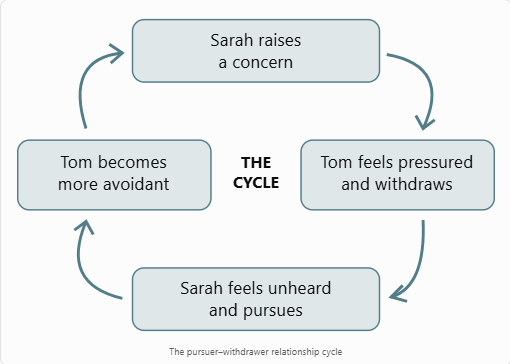
The pursuer and the withdrawer can become trapped in a destructive cycle.
The more one pushes, the more the other withdraws. The more one withdraws, the more the other pushes.
Breaking that cycle requires each person to examine their own behavior.
That doesn't mean both partners are equally responsible for every problem, especially when abuse or coercion is present.
It means each person is responsible for how they choose to show up in the relationship.
You cannot force your partner to become relational. But you can stop contributing to an unhealthy pattern through your own losing strategies.
It's Time for Mr. Nice Guy to
Wake Up

Being a nice person isn't the same as being a relational person.
A relational person can have difficult conversations.
A relational person can hear uncomfortable feedback.
A relational person can acknowledge their mistakes without falling apart.
A relational person understands that their partner's emotional experience matters, even when it makes them uncomfortable.
If your version of keeping the peace requires your partner to silence themselves, you're not creating peace.
You're creating distance.
And eventually, that distance can cost you your emotional connection, your physical intimacy, and possibly your relationship.
You don't have to become more aggressive or confrontational.
You need to become more emotionally courageous.
Stop trying to protect yourself from every uncomfortable conversation and start becoming someone your partner can actually have one with.
That's where real intimacy begins.
That's where real change happens.
That's the relationship shift.
Watch the Conversation on my You Tube Channel
In my episode of Real Relationships with Richie Pryor, I take a deeper look at how conflict avoidance can become a hidden form of control, why we develop these behaviors, and what we can do to change them.
Ready to Shift Your Relationship?
If you're tired of having the same arguments, walking on eggshells, or feeling emotionally disconnected from your partner, Relational Life Therapy can help you recognize and change the patterns that keep you stuck.
Learn more about couples counseling, relationship coaching, and relationship workshops at www.richiepryor.com.
Richie Pryor, LMHC
Certified Relational Life Therapist
Creator of The RelationShifter
Host of Real Relationships with Richie Pryor