
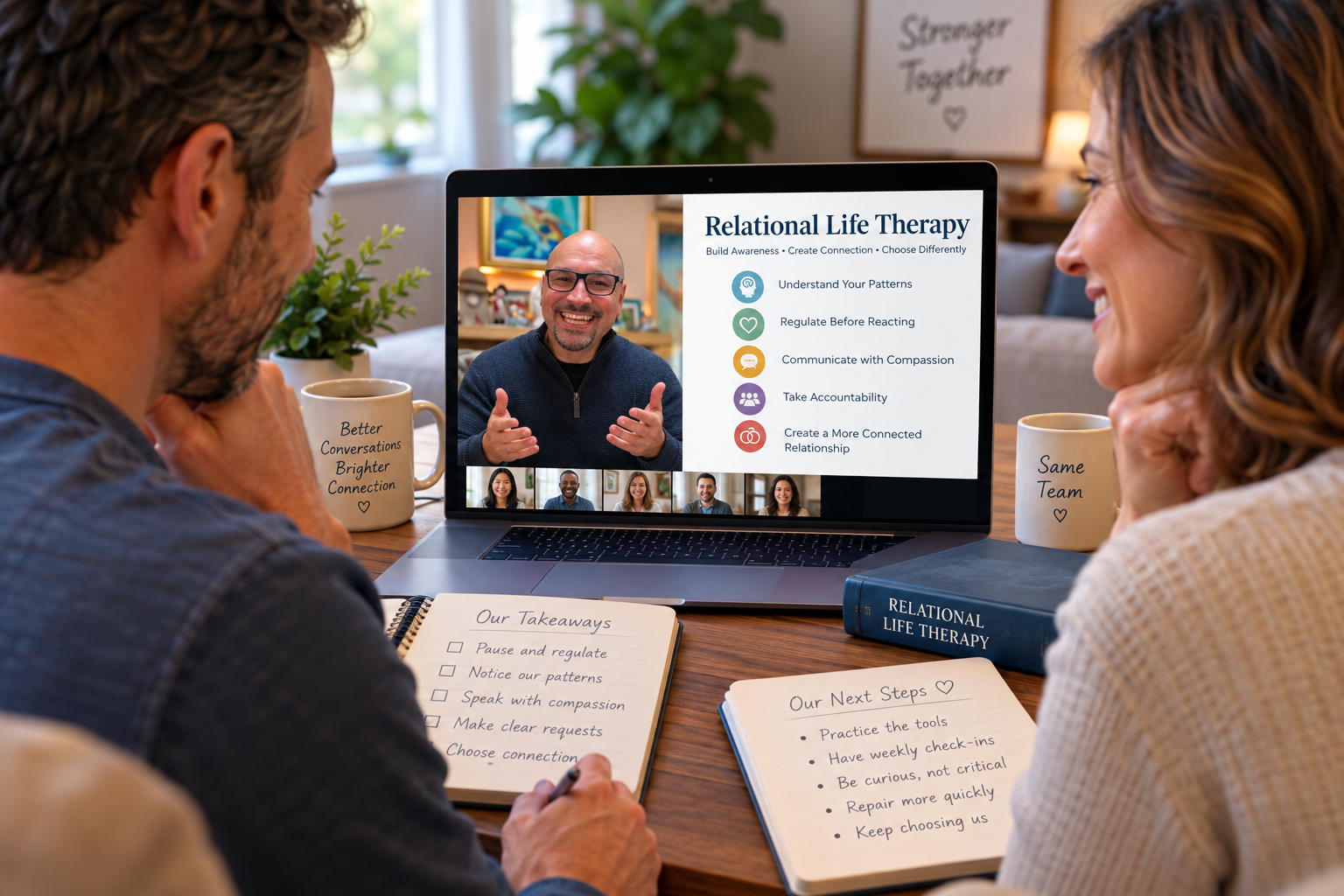
Relationship Coaching
Reignite Your Connection
Online Relationship Coaching for Couples & Individuals
Stop Repeating the Same Relationship Patterns. Start Building the Relationship You Want.
Practical, honest, and transformative relationship coaching based on the principles of Relational Life Therapy (RLT). Available online to individuals and couples worldwide, where permitted.
Are you tired of having the same arguments, feeling disconnected from your partner, or wondering why your relationships keep following the same frustrating patterns?
Maybe you feel like you're walking on eggshells. Perhaps you're always the one pursuing connection while your partner shuts down. Or maybe you know your reactions aren't helping your relationship, but you can't seem to stop yourself in the moment.
Here's something I've learned from years of working with couples: Knowing what isn't working doesn't necessarily mean you know how to change it.
That's where relationship coaching comes in.
I'm Richie Pryor, LMHC, a couples therapist and relationship coach trained in Relational Life Therapy. I help individuals and couples develop the awareness, communication skills, and practical tools necessary to create healthier, more connected relationships.
Whether you're in a relationship, married, dating, or trying to understand your own relationship patterns, my online relationship coaching offers a direct, compassionate, and sometimes humorous approach to making meaningful changes.
[Schedule a Relationship Coaching Consultation]
What Is Relationship Coaching?
Relationship coaching is a practical, forward-focused process designed to help you understand how you show up in relationships and learn healthier ways to connect with others.
Unlike traditional psychotherapy, which may involve diagnosing and treating mental health conditions, relationship coaching focuses on developing relationship skills, identifying unhelpful behaviors, strengthening communication, and creating actionable changes.
We don't just talk about what's going wrong.
We work on what you can do differently.
Together, we focus on recognizing patterns, developing new skills, practicing healthier responses, and taking responsibility for the changes within your control.
Relationship coaching can help you:
Stop having the same arguments over and over.
Communicate without defensiveness, criticism, or shutting down.
Recognize how childhood experiences influence your relationship behaviors.
Understand why you pursue, withdraw, avoid, or become emotionally reactive.
Develop healthy boundaries without guilt or resentment.
Build emotional intimacy and meaningful connection.
Replace blame and defensiveness with accountability.
Learn how to repair your relationship after disagreements.
Become a healthier partner, regardless of whether your partner participates.
You don't have to wait for your partner to change before you begin changing how you show up in your relationship.
Relationship Coaching Based on Relational Life Therapy (RLT)
Learn to Stop Doing What Doesn't Work
My relationship coaching approach draws from Relational Life Therapy (RLT), developed by internationally recognized couples therapist Terry Real.
RLT emphasizes accountability, relational awareness, emotional maturity, and the practical skills needed to build healthy relationships.
One of the central ideas behind RLT is that many of the behaviors that damage our adult relationships began as ways of protecting ourselves when we were younger.
These behaviors may have helped us navigate difficult childhood experiences, but they can create distance, resentment, and conflict in adult relationships.
For example:
You learned to shut down emotionally because expressing your feelings wasn't safe.
You became defensive because mistakes were met with criticism.
You learned to please others because conflict felt threatening.
You became controlling because uncertainty created anxiety.
You learned to pursue reassurance because emotional connection felt unpredictable.
These responses may have served a purpose in the past.
But what protected you as a child may be hurting your relationships as an adult.
In relationship coaching, we explore these patterns as they relate to present-day behavior and focus on developing healthier relationship skills.
We don't use coaching to diagnose or treat childhood trauma or mental health conditions.
Instead, we work toward greater awareness, personal accountability, and intentional change.
The Five Losing Strategies That Keep Couples Stuck
In Relational Life Therapy, Terry Real identifies five common losing strategies that people use when they feel hurt, threatened, or disconnected.
Unfortunately, these strategies often make relationship problems worse.
1. Being Right
You become so focused on proving your point that you lose sight of understanding your partner.
2. Controlling Your Partner
You try to manage your partner's feelings, behaviors, or decisions instead of focusing on what you can control.
3. Unbridled Self-Expression
You say whatever you're feeling without considering the impact your words have on your partner.
4. Retaliation
You respond to hurt by hurting your partner back, creating cycles of resentment and emotional distance.
5. Withdrawal
You shut down, avoid conversations, or emotionally disconnect when things become uncomfortable.
Most of us use at least one of these strategies, particularly when we're emotionally triggered.
Through relationship coaching, you'll learn to recognize these behaviors, understand their impact, and replace them with healthier ways of communicating and connecting.
The goal isn't to win the argument. It's to stop losing the relationship.
Relationship Coaching for Couples
Stop Fighting Against Each Other and Start Working Together
Many couples don't struggle because they don't love each other.
They struggle because they don't know how to navigate conflict, communicate effectively, or repair the relationship when things go wrong.
You may recognize some of these patterns:
One partner pursues while the other withdraws.
Small disagreements turn into major arguments.
You feel criticized, dismissed, or misunderstood.
Conversations quickly become defensive.
Emotional intimacy has gradually disappeared.
You avoid difficult conversations to keep the peace.
You feel more like roommates than romantic partners.
My online couples coaching helps partners recognize these dynamics and practice new relationship skills.
We'll focus on communicating more effectively, managing disagreements, understanding each other's perspectives, and taking responsibility for individual behaviors.
Rather than deciding who's right or wrong, we'll work toward developing the skills necessary to create a more respectful and connected partnership.
[Explore Online Couples Coaching]
Relationship Coaching for Individuals
You Can Change Your Relationship Even When Your Partner Isn't Ready
One of the biggest misconceptions about relationship improvement is that both partners must participate before anything can change.
While both partners contribute to relationship dynamics, you can begin working on your own behaviors, reactions, communication, and boundaries independently.
Individual relationship coaching may be especially helpful if you:
Feel stuck in repetitive relationship patterns.
Struggle with defensiveness, anger, or emotional withdrawal.
Find yourself constantly seeking reassurance.
Have difficulty establishing or maintaining boundaries.
Feel responsible for your partner's happiness.
Want to become a better partner.
Are dating and want to avoid repeating past mistakes.
Want to communicate your needs without criticism or blame.
You cannot control your partner's choices.
But you can learn to recognize your own patterns and respond more intentionally.
Sometimes changing your side of the relationship dynamic is the first step toward creating something different.
My R.E.L.A.T.E. Method™ for Healthier Relationships
I incorporate my R.E.L.A.T.E. Method™ into relationship coaching to help clients turn awareness into practical, everyday relationship skills.
R — Regulate Before Reacting
Learn to recognize emotional triggers and slow down reactive responses before they escalate conflict.
E — Examine Your Adaptive Child
Identify protective relationship behaviors learned earlier in life and recognize when they interfere with your present-day relationships.
L — Let Go of Losing Strategies
Replace defensiveness, control, retaliation, and withdrawal with more effective relational behaviors.
A — Act With Accountability
Take responsibility for your words, actions, and impact without falling into shame or blame.
T — Tell the Truth With Compassion
Communicate honestly and directly while maintaining respect for yourself and your partner.
E — Engage in Repair
Learn how to acknowledge hurt, take responsibility, and rebuild connection after disagreements.
Healthy relationships aren't built by avoiding conflict. They're built by learning how to navigate conflict and repair effectively.
How Online Relationship Coaching Works
Relationship coaching is offered through convenient, private video sessions, allowing individuals and couples to participate from their homes or other suitable locations.
Step 1: Identify Your Relationship Goals
We'll discuss the relationship challenges you're experiencing and identify the specific skills or behaviors you'd like to change.
Step 2: Recognize Your Patterns
We'll explore the communication habits, emotional reactions, and relational strategies that may be keeping you stuck.
Step 3: Learn Practical Relationship Skills
You'll learn strategies informed by RLT to improve communication, establish boundaries, manage conflict, and strengthen connection.
Step 4: Practice Between Sessions
Real change happens outside our conversations. You'll have opportunities to apply what you're learning to everyday relationship situations.
Step 5: Evaluate Your Progress
We'll review what's working, identify continuing challenges, and refine your approach as you build greater confidence in your relationship skills.
My coaching style is direct, collaborative, compassionate, and practical.
I believe in accountability without shame, honesty without cruelty, and making room for humor when appropriate.
Online Relationship Coaching Available Worldwide
Relationship Skills Don't Have Geographic Boundaries
You don't have to live in Massachusetts or Florida to benefit from my relationship coaching services.
I offer online relationship coaching to individuals and couples throughout the United States and internationally, where coaching services are legally permitted.
Whether you're in California, New York, Texas, Canada, the United Kingdom, or elsewhere, we can explore whether online relationship coaching is appropriate and available in your location.
As a Licensed Mental Health Counselor in Massachusetts and Florida, I distinguish my licensed psychotherapy services from my relationship coaching services.
Important distinction: Relationship coaching is an educational, skills-based service. It is not psychotherapy, mental health counseling, diagnosis, or treatment. I provide psychotherapy only in jurisdictions where I am legally authorized to practice. Coaching availability is subject to applicable laws and regulations, and coaching is not a substitute for mental health treatment.
If your needs involve mental health treatment, trauma processing, significant psychological distress, or clinical concerns, I may recommend working with an appropriately licensed mental health professional in your location.
Why Work With Richie Pryor?
Real Experience. Practical Skills. No Endless Blame Game.
I'm Richie Pryor, a Licensed Mental Health Counselor and couples therapist trained in Relational Life Therapy.
My professional experience working with couples and individuals has taught me that relationship problems often have less to do with a lack of love and more to do with patterns of behavior that people don't know how to change.
I've also been married for more than 40 years.
And if there's one thing a long marriage teaches you, it's that healthy relationships aren't about always getting it right.
They're about learning how to handle the times you get it wrong.
I bring both my professional experience and a grounded, real-world perspective to relationship coaching.
My approach is:
Direct: I'll help you recognize behaviors that may be contributing to relationship problems.
Compassionate: Understanding why you developed a behavior matters, even when you're responsible for changing it.
Practical: You'll learn skills you can apply in everyday situations.
Accountability-focused: We'll focus on what you can change rather than trying to control someone else.
Relatable: Relationships are complicated enough. We don't need to make the process of improving them more complicated.
My goal is to help you become more intentional, emotionally mature, and effective in your relationships.
Frequently Asked Questions About Relationship Coaching
What is the difference between relationship coaching and couples therapy?
Relationship coaching focuses on relationship education, communication skills, personal accountability, and future-oriented behavioral changes.
Couples therapy is a licensed clinical service that may involve assessment, diagnosis, and treatment of mental health or relational concerns.
Although my coaching approach draws from principles of Relational Life Therapy, coaching sessions are not psychotherapy or RLT clinical treatment.
Can I receive relationship coaching if I live outside Massachusetts or Florida?
Potentially, yes. I offer online relationship coaching to individuals and couples in locations where providing these nonclinical services is legally permitted.
Availability depends on the laws and regulations applicable to your location and the nature of the services you need.
Can relationship coaching help if my partner refuses to participate?
Yes. Individual relationship coaching can help you identify your own patterns, improve communication, establish healthier boundaries, and develop greater accountability.
While you cannot control your partner's behavior, you can change how you respond and participate in relationship dynamics.
Is online relationship coaching effective?
Online coaching offers opportunities to learn, practice, and apply relationship skills in everyday life. Its usefulness depends on your goals, participation, circumstances, and the appropriateness of coaching for your needs.
Results vary, and coaching cannot guarantee a particular relationship outcome.
Can relationship coaching help us stop arguing?
Relationship coaching can help you recognize recurring conflict patterns, communicate more effectively, and learn strategies for managing disagreements.
The goal isn't to eliminate every argument. It's to help you approach conflict in healthier, more constructive ways.
Do we need to be married to participate?
No. Relationship coaching is available to married couples, unmarried partners, dating individuals, and people who want to improve their relationship skills.
Is relationship coaching appropriate for every couple?
No. Coaching may not be appropriate when there is ongoing abuse, coercive control, serious safety concerns, or mental health needs requiring clinical treatment. These situations may call for specialized professional support rather than couples coaching.
Ready to Stop Repeating the Same Relationship Patterns?
You Don't Need a Perfect Relationship. You Need Better Relationship Skills.
Whether you're struggling with communication, feeling emotionally disconnected, or simply wanting to become a healthier partner, online relationship coaching can help you develop the skills to approach your relationships differently.
You don't have to keep repeating the same arguments.
You don't have to keep relying on the same losing strategies.
And you don't have to wait until your relationship reaches a breaking point before learning something new.
The first step toward changing your relationship is changing how you show up in it.
[Schedule Your Online Relationship Coaching Consultation]
Richie Pryor, LMHC
Relationship Coach | RLT-Trained Couples Therapist
Richie Pryor Psychotherapy
Online relationship coaching available to individuals and couples worldwide where legally permitted. Licensed psychotherapy available only where authorized.